AI search optimization
SEO vs. AEO vs. GEO: what’s different, what’s the same, and how to win all three
Three acronyms, one job: getting your business found, understood, and recommended when someone asks a question you can answer. Here is how they differ, where they overlap, what the 2026 data says, and the order to do the work in.
Search Engine Optimization. Rankings and clicks on a results page. The foundation.
Answer Engine Optimization. The passage that gets lifted into a snippet, an AI Overview, or a chatbot reply.
Generative Engine Optimization. Your brand named inside a generated answer, with or without a link.
Executive summary
SEO gets you found. AEO gets you quoted. GEO gets you recommended. They share one foundation, one set of signals, and one measurement problem, so they should be run as one program with three outputs, not three retainers.
- SEO earns rankings and clicks from Google’s results page. It is the technical and content foundation everything else depends on.
- AEO earns the quoted answer in featured snippets, AI Overviews, and chatbot responses. It is won at the passage level: a direct answer, under a question-shaped heading, backed by schema.
- GEO earns a brand recommendation inside a generated response from ChatGPT, Gemini, Perplexity, or Google AI Mode. It is won mostly off your site: third-party mentions, original data, consistent brand facts.
The numbers say the shift is real. 68% of U.S. Google searches ended without a click in early 2026. Only 38% of pages cited in Google AI Overviews rank in the top 10 for that query, down from 76% a year earlier. Branded web mentions correlate three times more strongly with AI visibility than backlinks do.
What to do: fix the technical foundation once, rewrite your highest-value pages so every section leads with a direct answer, publish something only you can publish, earn mentions where the models look, and track mentions and citations alongside rankings. The nine-step framework below is the order to do it in, and it is the same order we run our AI search optimization program.
A note on this summary: it is written the way I want clients to write theirs. First sentence answers the question. Each acronym gets one plain definition. Claims carry numbers. No preamble. If an answer engine lifted only the first paragraph, the reader would still get the point. That is the test. More on this in the FAQ at the end.
Three acronyms, one problem
SEO, AEO, and GEO are not three separate marketing programs. They are three layers of the same job. If a vendor is selling you them as three separate retainers, they are selling you the same work three times.
I have run an agency since 2015 and worked in search for more than 15 years. I have watched the industry rename itself several times. This one is different, because the behavior underneath it actually changed. 68.01% of U.S. Google searches ended without a click in the first four months of 2026, up from 60.45% in 2024, according to SparkToro’s analysis of Similarweb clickstream data. Two out of three searches now end on Google’s page, not yours.
At the same time, the people who do click out of an AI answer are worth more. Adobe measured AI-referred traffic to U.S. retail sites converting 42% better than other traffic in March 2026, and that traffic was up 393% year over year. Fewer clicks, better clicks. That is the environment every one of these acronyms is trying to describe.
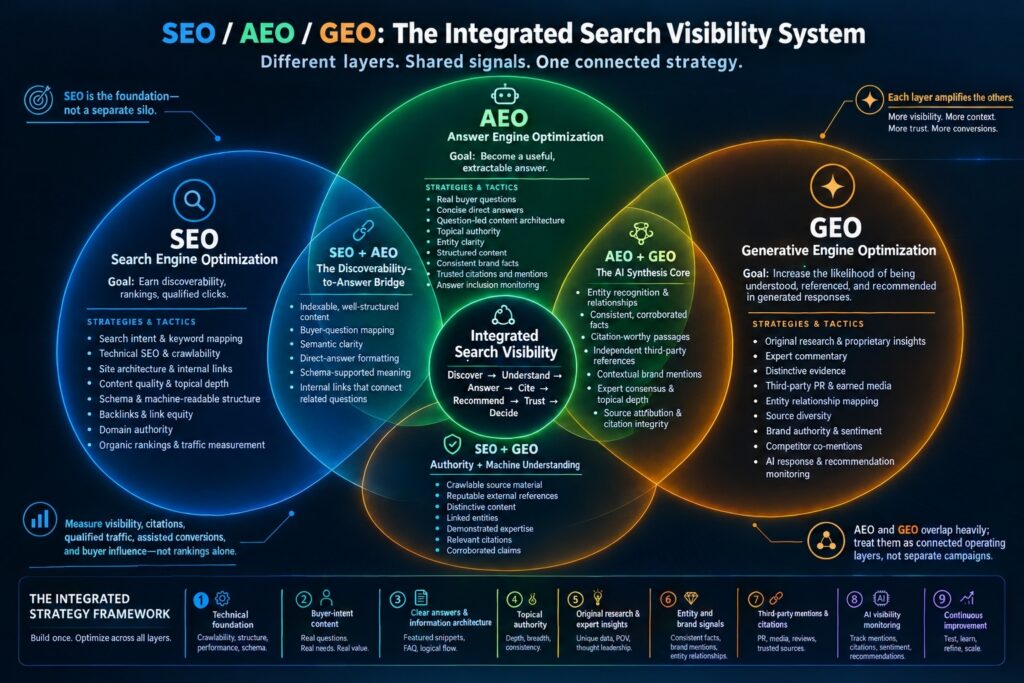
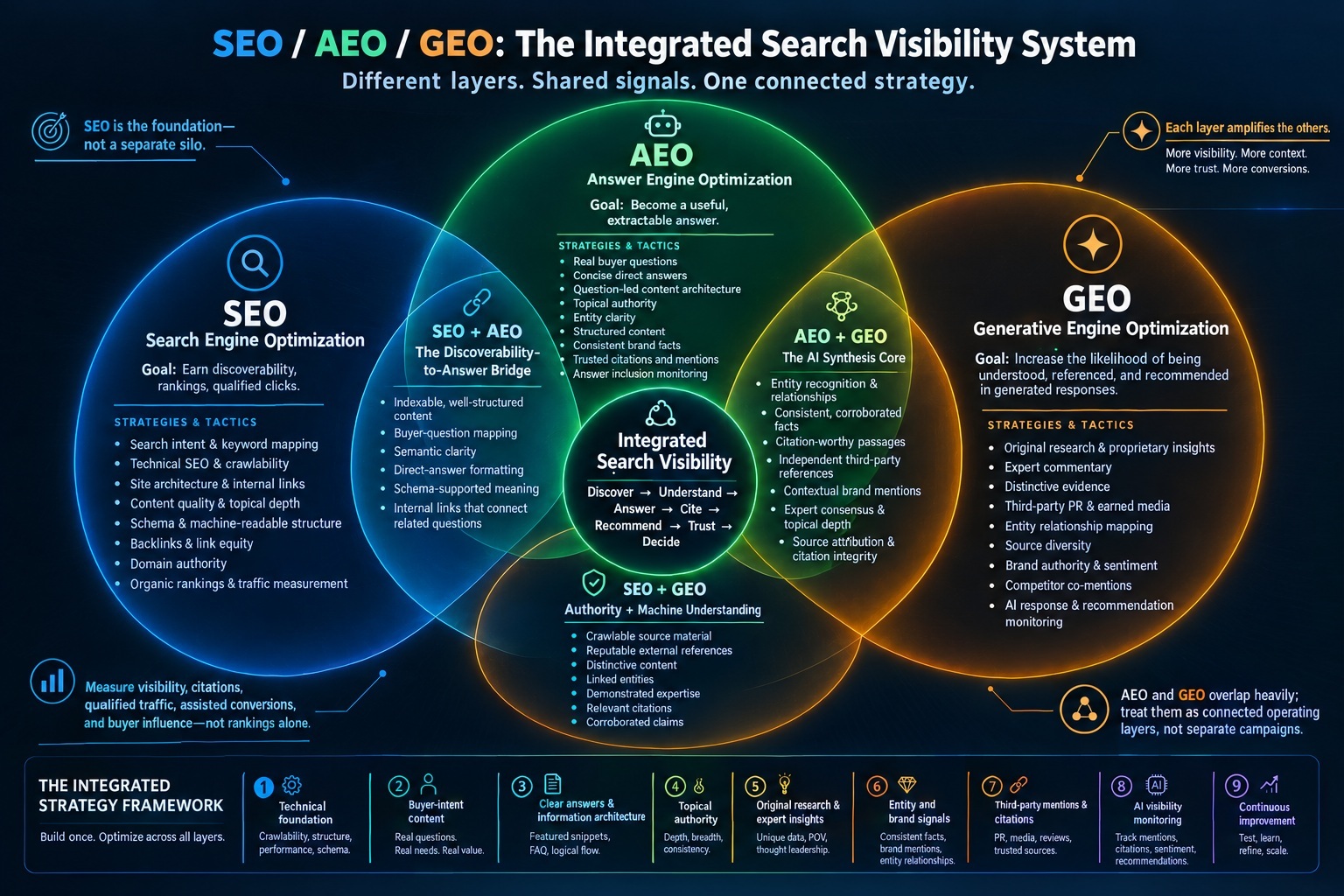
The infographic below is how I explain it to clients. Three overlapping circles, shared signals in the middle, and a nine-step framework underneath that you build once and apply across all of them.
What each one actually means
Strip the hype and each layer has one goal and a short list of tactics. Pick a layer.
Search Engine Optimization
Goal: earn discoverability, rankings, and qualified clicks.
- Search intent and keyword mapping
- Technical SEO and crawlability
- Site architecture and internal links
- Content quality and topical depth
- Schema and machine-readable structure
- Backlinks and link equity
- Domain authority
- Organic rankings and traffic measurement
Where the win shows up
A blue link on a results page that someone clicks.
SEO is the foundation, not a separate silo. If a crawler cannot reach your page, parse its structure, and understand what entity it is about, nothing downstream works.
Answer Engine Optimization
Goal: become a useful, extractable answer.
- Real buyer questions
- Concise direct answers
- Question-led content architecture
- Topical authority
- Entity clarity
- Structured content
- Consistent brand facts
- Trusted citations and mentions
- Answer inclusion monitoring
Where the win shows up
A featured snippet, an AI Overview, a voice assistant answer, or a cited line inside a chatbot response.
AEO is about the answer. The unit of success is not a page, it is a passage. Can a machine lift a two-sentence answer out of your content and attribute it to you?
Generative Engine Optimization
Goal: increase the likelihood of being understood, referenced, and recommended in generated responses.
- Original research and proprietary insights
- Expert commentary
- Distinctive evidence
- Third-party PR and earned media
- Entity relationship mapping
- Source diversity
- Brand authority and sentiment
- Competitor co-mentions
- AI response and recommendation monitoring
Where the win shows up
Your brand named as a recommendation in ChatGPT, Gemini, Perplexity, Claude, or Google AI Mode, with or without a link.
GEO is about the recommendation. Generative engines synthesize across many sources and decide whether to name you. That makes GEO as much a PR and reputation discipline as a content one.
AEO and GEO overlap heavily. In practice I treat them as connected operating layers inside one program, not separate campaigns. The difference is mostly where the answer ends up and how much of the credit you get for it.
How they are different
The differences are real, and they matter for how you staff, budget, and report. Three things separate the layers: who you are optimizing for, what a win looks like, and how loosely the win is tied to your rankings.
Who reads your content. SEO optimizes for a crawler and a human scanning ten links. AEO optimizes for an extraction system looking for the cleanest answer to a specific question. GEO optimizes for a language model building a synthesized recommendation from dozens of sources at once, most of which are not yours.
What a win looks like. In SEO, a win is a click. In AEO, a win is your passage being the one that gets quoted, which may or may not produce a click. In GEO, a win is your brand being named at all, often with no link and no visit. You can win GEO and see nothing in Google Analytics for that query. That is uncomfortable for anyone who has reported on organic traffic for 15 years, myself included.
How much your rankings carry you. This is where the data has moved fastest. In July 2025, Ahrefs found 76% of pages cited in Google AI Overviews also ranked in the top 10 for the same query. By early 2026 that was 37.9%, and roughly a third of citations came from pages outside the top 100 entirely. For ChatGPT, the link is weaker still: only 20.7% of citations for short-tail prompts appear anywhere in Google’s top 100 for the same query, and just 10% are in the top 10.
Read that carefully. Rankings still help. They are no longer sufficient, and for ChatGPT they are barely predictive. The engines are running fan-out queries, pulling from YouTube, Reddit, and reference sites, and weighing brand signals that have nothing to do with where your page sits on a results page.
| SEO | AEO | GEO | |
|---|---|---|---|
| Optimizing for | Crawler + human scanning results | Answer extraction (snippets, AI Overviews, assistants) | Generative synthesis across many sources |
| Unit of success | A ranking and a click | A quoted passage | A brand recommendation |
| Attributable traffic | High | Partial | Low, and often zero for the winning query |
| Rankings carry you | Nearly everything | A lot, but shrinking | A little |
| Biggest lever | Technical health, content, links | Question-led structure, direct answers, schema | Third-party mentions, original data, consistent brand facts |
| Time to movement | Months | Weeks to months | Months, and it compounds slowly |
How they are the same
The overlaps in the Venn diagram are where the work actually gets done. Almost every tactic in one circle is also a tactic in another. That is the whole argument for one program instead of three.
SEO + AEO: the discoverability-to-answer bridge. Indexable, well-structured content. Buyer-question mapping. Semantic clarity. Direct-answer formatting. Schema that confirms meaning. Internal links that connect related questions. Every one of these has been good SEO practice for a decade. AEO just raises the standard: the structure has to be clean enough that a machine can pull one passage out and still have it make sense.
AEO + GEO: the AI synthesis core. Entity recognition and relationships. Consistent, corroborated facts. Citation-worthy passages. Independent third-party references. Contextual brand mentions. Expert consensus and topical depth. Source attribution and citation integrity. This is the part most agencies are weakest on, because it is half content and half PR. The models want to see the same facts about you in several places they trust before they will repeat them. Named authorship is one of the cheapest ways to start; I wrote about using authorship to build AI citations earlier this year.
SEO + GEO: authority and machine understanding. Crawlable source material. Reputable external references. Distinctive content. Linked entities. Demonstrated expertise. Relevant citations. Corroborated claims. This is E-E-A-T restated for a different reader. Google has been asking for it since 2014. The generative engines are just stricter graders.
The center: integrated search visibility. Discover, understand, answer, cite, recommend, trust, decide. That is the buyer’s path, and each layer owns a piece of it. SEO gets you discovered. AEO gets you understood and quoted. GEO gets you cited and recommended. Trust and the decision happen downstream, often on a sales call, and that is where the attribution breaks.
The shared signals are the point. A clear entity, consistent brand facts, structured content, demonstrated expertise, and third-party corroboration feed all three engines at once. Build them once, and each layer amplifies the others. That is not a slogan, it is how the fan-out queries actually work: the model searches for you several different ways and checks whether the answers agree.
What the data says
Four findings shape how I run these programs. Each one points the same direction: the signals that win AI visibility are brand signals, and they are built mostly off your own site.
of U.S. Google searches ended without a click, Jan–Apr 2026
Source: SparkToro / Similarweb, June 2026
of AI Overview citations rank in Google’s top 10, down from 76%
Source: Ahrefs, 863K keywords, early 2026
branded web mentions correlate with AI visibility vs. backlinks (0.664 vs. 0.218)
Source: Ahrefs, 75,000 brands
conversion rate of AI-referred visitors vs. other traffic, U.S. retail
Source: Adobe Analytics, March 2026
1. Clicks are leaving the results page. 68.01% of U.S. Google searches ended with no click in January through April 2026, up from 60.45% in 2024. SparkToro notes the panel excludes Google’s mobile app, where the rate is likely higher. Whatever the exact figure, the share of searches that produce a visit has fallen by roughly a quarter in two years.
2. Rankings predict AI citations less every quarter. Ahrefs’ overlap between top-10 rankings and AI Overview citations fell from 76% to 38% in under a year. For ChatGPT it was never high. The engines are answering with fan-out queries, and the sources they pull are increasingly YouTube, Reddit, review sites, and reference pages rather than the page that ranks first.
3. Mentions beat links. Ahrefs’ study of 75,000 brands measured which factors correlate with a brand appearing in AI Overviews. The top three were all off-site brand signals, and backlinks landed well behind.
Spearman correlation with brand visibility in Google AI Overviews. Source: Ahrefs, AI Overview brand correlation study. Correlation is not causation, and Ahrefs says so.
The gap is large enough to change where you spend. Brands in the top quartile for web mentions earned 169 AI Overview mentions on average; brands in the bottom quartile earned zero, and 26% of brands studied had no AI Overview mentions at all.
4. The traffic that does come through is worth more. AI referrals are still small, around 1% of total site traffic in most benchmarks. But Adobe Analytics measured AI-referred visitors to U.S. retail sites converting 42% better than other traffic in March 2026, with that traffic up 393% year over year. Someone who arrives after an AI engine has already explained your category and named you is further down the funnel than someone who clicked a blue link.
One more, from Google itself. On May 15, 2026, Google published its first official documentation on optimizing for generative AI features in Search. I read it the day it came out and wrote our field guide to Google’s AI search guidance that same week, because clients were going to ask. Short version of what Google said: AI Overviews and AI Mode run on the core Search ranking systems, no llms.txt file, special markup, content chunking, or AI-specific rewrite is required, and optimizing for AI search is still SEO. I agree with Google about Google. The field guide walks through what to do with that. What it does not tell you is how ChatGPT, Perplexity, or Claude pick sources, and that is the part of this article I care most about.
Where I read the data differently
Yes, but.
The numbers above are the ones I trust. I still argue with how the industry reads them. Four places where I agree with the experts and then keep going.
-
Yes
Google says AI search is still SEO.
The May 2026 documentation is accurate about AI Overviews and AI Mode. Same crawler, same index, same ranking systems. No llms.txt, no special schema, no AI rewrite required. I broke it down point by point in our field guide, and I stand by every line of it.
ButGoogle only speaks for Google.
The guide says nothing about how ChatGPT, Perplexity, or Claude choose sources, and Ahrefs’ numbers show those engines barely look at Google’s top 10. Reading Google’s guide as permission to ignore the other engines is the most expensive misreading in the industry right now.
-
Yes
SEO is the foundation.
Nothing downstream works if the page cannot be crawled, parsed, and tied to a clear entity. The infographic says it and I stand by it.
But“Foundation” no longer means “ranking.”
When 76% of AI Overview citations came from the top 10, you could argue ranking was the job and AI visibility would follow. At 38%, with a third of citations from outside the top 100, the foundation is crawlability, structure, and entity clarity. Ranking is one output of that foundation, not the foundation itself.
-
Yes
AI traffic converts better.
Adobe measured it across U.S. retail: 42% better than other traffic. Someone who arrives after an engine has named you is further down the funnel.
ButMost of the conversion claims are vendor math.
The 5×, 14×, and 23× multipliers circulating in decks come from small samples, self-selected clients, or no published methodology. Fewer, better clicks is the honest claim. Put the big multipliers in a pitch and a sharp CFO will ask for the sample size.
-
Yes
Mentions correlate with AI visibility.
Three times more strongly than backlinks in the Ahrefs data. It is the clearest signal anyone has published about what generative engines reward.
ButCorrelation is not a brief.
Brands that get mentioned a lot are also older, bigger, and better funded, and all of that drives AI visibility too. The data tells you where to look, not that you can buy your way in with a mention campaign. The mentions that count say something true and specific about you in a place the models already trust. That is earned, slowly, and it is why original research sits before third-party mentions in the framework below.
The integrated strategy framework
Build once. Optimize across all layers. The nine steps at the bottom of the infographic are in the order I run them, because each one depends on the one before it.
Technical foundation
Crawlability, structure, performance, schema. If Googlebot or GPTBot cannot reach and parse the page, stop here.
SEOBuyer-intent content
Real questions, real needs, real value. Pull them from sales calls, support tickets, and the prompts people type into ChatGPT.
SEO, AEO, GEOClear answers and information architecture
The first sentence under every heading answers the heading. Featured-snippet formatting, FAQ sections, logical flow.
SEO into AEOTopical authority
Cover the whole subject, not one page per keyword. Link the related questions so the engine can see you own the topic.
SEO, AEOOriginal research and expert insights
Unique data, a point of view. The lever most companies skip because it is hard, and the only thing a generative engine cannot get from someone else.
GEOEntity and brand signals
Consistent facts about who you are, where you are, and what you do, everywhere they appear. The models cross-check. Make the answers match.
AEO, GEOThird-party mentions and citations
PR, media, reviews, YouTube, Reddit, trade press. Given the correlation data, this is where I would move budget from link building.
GEOAI visibility monitoring
Track mentions, citations, sentiment, and recommendations across the engines on a fixed set of buyer prompts, every month.
AEO, GEOContinuous improvement
Test, learn, refine, scale. The engines change weekly. The prompt set, the cited pages, and the competitors named will shift under you.
All layers
Steps 1 through 4 are SEO that happens to also serve AEO. Steps 5 through 7 are where GEO gets won or lost. Steps 8 and 9 are what keep the program honest. If you have an SEO retainer today and it does not include steps 5 through 8, that is the gap, and it is a scope conversation, not a new vendor.
How to measure it
Measure visibility, citations, qualified traffic, assisted conversions, and buyer influence. Not rankings alone. Rankings are still a leading indicator for the SEO layer. They tell you almost nothing about the other two.
| Layer | Primary metrics | Where they live |
|---|---|---|
| SEO | Impressions, clicks, average position, organic conversions | Search Console, GA4 |
| AEO | Featured snippet ownership, AI Overview and AI Mode impressions, passages cited | Search Console’s generative AI performance report, AI visibility tracking |
| GEO | Share of brand mentions across a fixed prompt set, citation count, sentiment, competitor co-mentions, AI referral conversions | AI visibility tracking, GA4 referral and source reports, CRM |
Three habits make this work. First, pick a fixed set of 50 to 100 buyer prompts and test them every month across the engines that matter for your market. Changing the prompts changes the baseline. This is the first thing we set up in every AI search engagement, before any content changes, because you need the before picture. Second, segment AI referrals in GA4 and push that source into the CRM so you can see what those leads turn into. Third, watch branded search volume and direct traffic alongside everything else. When GEO is working, people hear about you in a chat window and then type your name into Google. That shows up as brand demand, not as a referral.
The uncomfortable part is attribution. A buyer can ask ChatGPT for a shortlist, see your name, ask three follow-up questions, Google you, read two reviews, and fill out your form from a direct visit. The AI engine did most of the work and gets none of the credit. Report it anyway. Put mentions and citations in the same monthly report as rankings, and make the case that they lead the brand-search line by a few weeks.
Where I land
SEO, AEO, and GEO are one discipline with three outputs. The foundation is the same site, the signals are the same facts and the same expertise, and the measurement problem is the same attribution gap. The difference is where the answer shows up and how much of the credit comes back to you.
If I were starting a program Monday morning, I would audit the technical foundation, rewrite the ten most valuable pages so every section leads with a direct answer, publish one piece of original data this quarter, go get mentioned in five places the models actually read, and start tracking 50 buyer prompts across the engines before I did anything else. That is one plan. It serves all three circles.
FAQ
What is the difference between SEO, AEO, and GEO?
SEO earns rankings and clicks on a search results page. AEO earns the quoted answer in snippets, AI Overviews, and assistants. GEO earns a brand recommendation inside a generated response. All three run on the same technical foundation and the same brand signals.
Is GEO just SEO with a new name?
No. GEO rewards things SEO never measured well: third-party mentions, consistency of brand facts across the web, and original data. Ahrefs found branded web mentions correlate with AI Overview visibility at 0.664 versus 0.218 for backlinks. Google’s own May 2026 guidance says its AI features run on core Search systems. Both are true. The foundation is SEO; the levers that separate winners in generative engines are mostly off-site.
Do I need an llms.txt file?
Not for Google. Google’s May 2026 documentation says llms.txt, special markup, and AI-specific rewrites are not used by Search; our field guide covers the full list of what Google says you can skip. Other engines have not published equivalent guidance. It costs nothing to add, so I do it, but I do not sell it as a lever.
Does schema still matter?
Yes, for the same reason it always has: it confirms what an entity and a passage are about. Google says no special schema is required for AI features. That is different from saying schema does not help. FAQPage, Organization, LocalBusiness, and Article markup remain part of the foundation.
How long until AEO or GEO shows results?
Expect a quarter. Answer-level changes to existing ranking pages can show up in snippets and AI Overviews within weeks. Brand mentions and generative recommendations build over three to six months and compound. Track a fixed set of buyer prompts monthly so you can see the curve.
How do I measure GEO if there is no click?
Track a fixed set of 50 to 100 buyer prompts across the engines every month and record whether you are mentioned, cited, and how. Pair that with branded search volume, direct traffic, and AI referral conversions in GA4 and the CRM. Report mentions next to rankings.
Should I hire a separate AEO or GEO agency?
If your current SEO partner is not doing steps 5 through 8 of the framework, fix the scope first. The work overlaps too much to split across vendors without duplicating the foundation and losing the shared signals.
Going meta: What a good FAQ answer looks like
Everyone says LLMs love FAQs. Enough people have repeated it that an FAQ section has become a checkbox: add one, mark AEO done. I added one above, and it is a fair example. But do not be fooled by the format. An FAQ is just text a machine can lift out, wrapped in schema markup, that still makes sense to a human when it lands somewhere else. The schema gets it noticed. The writing gets it used. The real AEO test is a writing test.
Here is the same question answered badly and well.
Question: How long does GEO take to work?
Bad answer
Great question! GEO is an exciting new frontier in digital marketing, and like any strategy, results depend on many factors including your industry, competition, current authority, and the scope of your program. Every business is different, so it’s hard to give a one-size-fits-all timeline. That said, with a consistent, holistic approach and a trusted partner, you’ll start to see momentum build over time. Reach out to learn more!
Good answer
Expect a quarter. Changes to existing pages can affect AI Overview citations within weeks. Brand mentions and generative recommendations build over three to six months and compound. Track a fixed set of buyer prompts monthly so you can see the curve.
What changed:
- The first sentence is the answer. The bad version spends 60 words not answering.
- Numbers replace adjectives. “A quarter” and “three to six months” can be quoted. “Over time” cannot.
- No preamble, no hedge, no pitch. An engine extracting the passage drops all three anyway, and a reader skims past them.
- It stands alone. Pull the good answer out of this page and it still works. Pull the bad one and you have a disclaimer.
The same rules apply to an executive summary. Lead with the conclusion, define each term once in plain words, attach a number to every claim that has one, and make the first paragraph survive on its own. Then write the rest of the document to support it. The summary at the top of this article is built that way on purpose.
Find out where you stand in AI search
We test the buyer questions in your market across ChatGPT, Gemini, Perplexity, and Google AI Mode and show you who gets named, who gets cited, and where you are missing. One program, three outputs.
Request an AI Visibility AuditSources
- Search Engine Land: Google zero-click searches hit 68% in early 2026 (SparkToro / Similarweb)
- Ahrefs: Update, 38% of AI Overview citations pull from top 10 pages
- Ahrefs: AI Overview brand correlation study, 75,000 brands
- Ahrefs: AI SEO statistics (ChatGPT citation overlap with Google top 100)
- Google Search Central: Optimizing for generative AI features on Google Search
- Paradigm Media Networks: AI search statistics 2026 (Adobe Analytics retail conversion figures, secondary source)