August 17: The Smart Bidding Update Ends Your Efficiency Cushion
Budget-limited campaigns using Target CPA or Target ROAS will now “more consistently perform toward your bid target.” Google’s own example: a campaign with a $10 Target CPA that has been delivering $5 conversions will drift toward $10. The change applies to Search, Shopping, Performance Max, Demand Gen, Display, Hotel, and Travel campaigns. App and Video campaigns keep the old behavior.
The nuance most coverage missed: after advertiser pushback, Google Ads Liaison Ginny Marvin clarified that this will not increase campaign spend, and Google will not touch your targets or budgets automatically. The risk is not runaway spend. It is efficiency compression. If you have been running a $70 Target CPA as a loose ceiling while actually landing leads at $40, that gap closes toward $70 — same spend, fewer conversions.
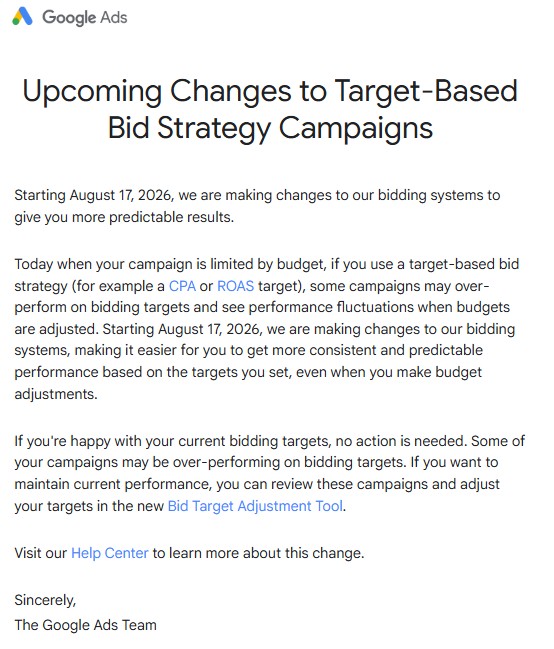
What to do: Pull every budget-limited campaign that is beating its target. Reset targets to match recent actual performance, either manually or with the Bid Target Adjustment tool that is live in accounts now. Campaigns already performing at target see no change.
August 18: The Content API for Shopping Shuts Down
The legacy Content API for Shopping shuts down permanently. Every integration that reads or writes Merchant Center data — feed platforms, e-commerce apps, custom scripts, middleware — must be on the new Google Merchant API.
Who is exposed: custom-built API integrations and any feed tool that has not migrated. A connection still calling the legacy API on the 18th stops syncing prices and stock, which cascades into stale data, disapprovals, and paused Shopping ads.
Who is insulated: file-based and scheduled-upload feed sources are not API calls and keep working. Shopify stores on the Google & YouTube channel app get migrated on Shopify’s side. Major feed platforms have published migration timelines — confirm rather than assume.
What to do: Inventory every path product data takes into Merchant Center. Check anything custom-coded against the Merchant API migration guide. Send anything third-party a one-line email: “Are we fully on Merchant API?”
August 31: Local Inventory Ads Turn On by Default
Shopping campaigns align with Performance Max by enabling local inventory by default. The campaign-level enable_local API flag will be ignored, and setting it to false triggers errors in newer API versions.
If you run separate budgets or ROAS goals for online versus in-store, the campaign toggle you relied on no longer exists. Without action, local inventory starts absorbing budget from campaigns you built for online-only sales.
What to do: Set an explicit inventory filter with Channel = Online on any campaign that should stay online-only. While you are in the feed, check your product IDs: if you sell both online and in-store, stop reusing the same ID across channels when price, availability, or promotions differ. Google treats online attributes as the baseline, and conflicting channel data on a shared ID now drives disapprovals.
September: Dynamic Search Ads Upgrade to Google AI Max
New DSA creation ends across Google Ads, Ads Editor, and the API in September, and eligible Dynamic Search Ads campaigns begin auto-upgrading to AI Max. Dynamic ad groups become standard ad groups with search term matching, text customization, and final URL expansion enabled. Legacy URL controls carry over. The full sunset for remaining campaigns was extended to February 2027.
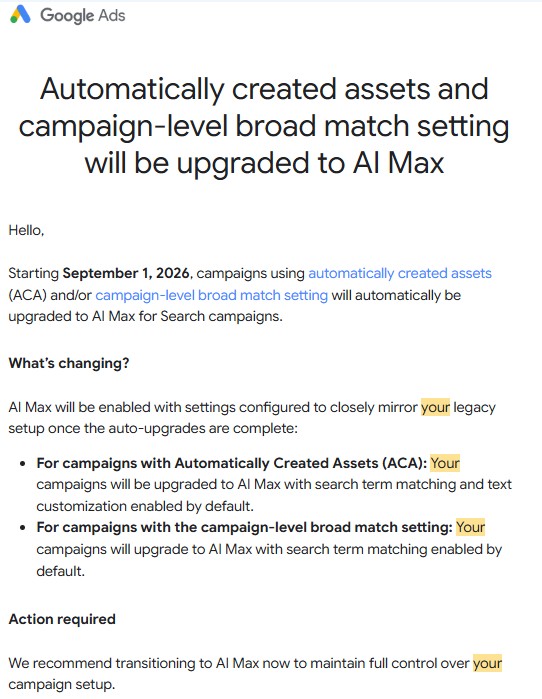
What to do: Upgrade on your own schedule instead of Google’s. The manual upgrade tool ports historical settings and data, and one-click experiments let you measure AI Max against your current setup before committing everything.
On Deck: Display’s Merge Into Demand Gen
One more consolidation is coming, but without a deadline yet. Google began a phased rollout of a migration tool in June 2026 that moves existing Display campaigns to “Google Display Network on Demand Gen.” Migration is voluntary for now. The two dates that will matter — when new Display campaign creation gets restricted to Demand Gen, and when remaining campaigns auto-migrate — are both listed as “coming later,” and Google notes the timeline is subject to change.
If you migrate early, budgets, campaign status, audiences, and the last 42 days of performance data carry over. What doesn’t: manual CPC, bid adjustments, and certain audience types aren’t supported in Demand Gen and need to be reworked first. That rework is the real reason to plan ahead — accounts leaning on manual bidding will need a strategy change, not just a button click. We’ll update this post when Google puts dates on it.
Already Live: Video Cards, the Policy Merge, and Image Warnings
Three changes from earlier this year are worth catching up on if they slipped past. Since April 14, the video_link attribute lets you attach product videos to your feed, and as of June 30 those videos are eligible to serve on Shopping product cards — early adopters get video-rich listings while competitors show static images. In July, Google merged its Shopping ads and free listings policies into a single policy set, with no new merchant restrictions added. And Merchant Center has been flagging images under 500×500 pixels since April, which matters because of what comes next.
January 31, 2027: The Image Quality Deadline
Minimum image resolution becomes 500×500 pixels for image_link and additional_image_link across all product categories and marketing methods. Below that, products get disapproved — not warned, disapproved. Legacy catalog items and marketplace-sourced images are the usual offenders.
What to do: Sort the image warnings in Merchant Center now, not in January.
Your Merchant Center Feed Now Matters Beyond Google
One more reason the Merchant API migration is worth doing right: TikTok Ads Manager can import product catalogs directly from Google Merchant Center to power its catalog ads. A clean, well-attributed feed is no longer just a Shopping ads input. It is the source of truth feeding your multi-channel product advertising, and investment in feed quality now compounds across platforms.
What to Do This Week
- Audit budget-limited Target CPA and Target ROAS campaigns and reset targets to actual performance — before August 17.
- Confirm every Merchant Center integration is on the Merchant API — before August 18.
- Add Channel = Online inventory filters to online-only Shopping campaigns — before August 31.
- Split product IDs across channels where attributes differ.
- Clear sub-500×500 image warnings and plan your DSA-to-AI-Max upgrades on your own timeline.
Managing this across a dozen client accounts is exactly the kind of week where things slip. If you want a second set of eyes on your bidding targets or feed setup before the deadlines hit, reach out.