How to Reverse Engineer ChatGPT Ads With AEO Tracking Software
In case you missed it: ChatGPT runs ads now. Sponsored cards at the bottom of answers, matched to whatever you happen to be talking about — roughly the way Google runs ads against searches. Roughly. Hang onto that word. The gap between “roughly like Google” and “actually like Google” is where everything interesting in this post lives.
Because here’s what nobody mentions: there’s no ad library. No transparency center, no searchable archive, no place to type a competitor’s name and scroll through what they’re running. Google gives you one. Meta gives you one. OpenAI gives you nothing.
So, if you want to know who’s advertising against your category, which prompts trigger ads and which don’t, and what the targeting actually looks like, you’ve got two options.
Option one: Open ChatGPT and start typing. Log what you see. Do it again tomorrow, because it changes. And the next day. Forever, basically, and you still won’t have a sample you can trust.
Option two: Let the software fire the prompts every day and log it for you while you sleep.
Now, the part that should make our AEO clients even happier? If you’re already running AEO tracking software with us, option two is something you already have! Because the software screen captures every result daily, you have an archive of competitor ad data at your fingertips.
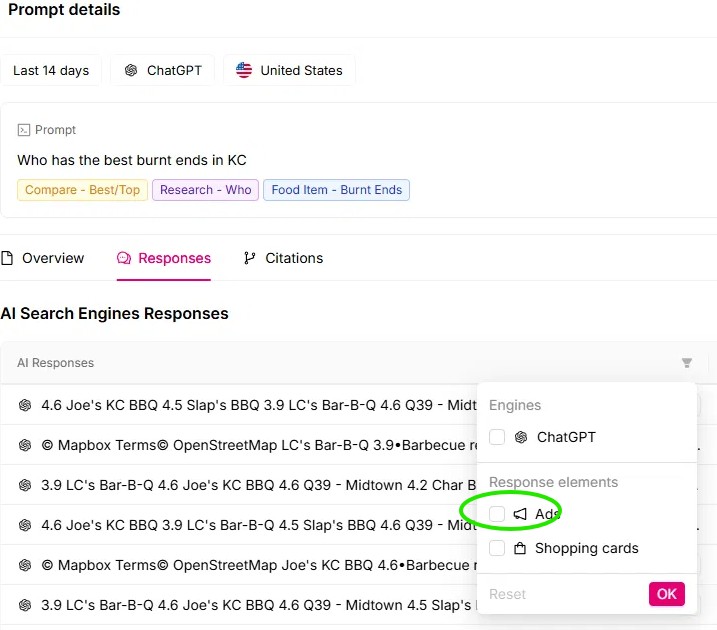
Furthermore, pages with ads can be filtered by day and exact prompt. Our media team loves this way more than spending hours on competitive research manually.
Why is this worth doing now?
Every ad channel has an era in which the people paying attention hold an unfair advantage over those waiting for the tooling to mature. Google had one. Facebook had one. Now, early adoption of ChatGPT Ads has no barrier. So, while most teams are still arguing about whether AEO is real, your brand could be appearing organically and with a sponsored ad.
Reverse Engineering
ChatGPT ads serve inside private, one-to-one conversations, which is why OpenAI hasn’t built an archive and probably won’t build the ad transparency tool you’re picturing. Regulation might eventually force something thin — the EU’s Digital Services Act already requires large platforms to maintain ad repositories — but a compliance archive tells you who ran an ad and roughly when. Not which prompt triggered it, or why.
Today, we have AEO and GEO platforms. They work by running a fixed set of prompts through the AI engines on a schedule and capturing the output. The intent is organic — brand mentions, domain citations, share of voice. But the capture doesn’t discriminate. It grabs the whole response. And since February 9, 2026, a growing share of those responses have carried a sponsored card at the bottom.
Your organic monitoring stack has been running a controlled experiment against OpenAI’s ad system for months. Every scheduled capture is a probe. Every ad that lands in one is a data point about how the system behaves.
The Insights You Can Infer
1 — Who’s advertising? This is the obvious first step in the process, but don’t stop here. Look at the words they use, the call-to-action used in their ad copy. Then compare others and see how different ads may be better at winning clicks vs. other competition.
2 — What ChatGPT considers monetizable. Which prompts get ads, and how often? The system is telling you which parts of your category it has classified as commercially viable, before you spend a dollar finding out. This helps our media team create ad campaigns that don’t sit dormant and set proper budget expectations for clients.
2 — Who’s bought in. Advertiser names and display URLs against your prompts show you how well ChatGPT is targeting ads. Ad relevancy is often the most important part.
3 — Where the category boundary sits. Who shows up that shouldn’t. This is the highest-value inference in the set and I’ll come back to it. For now, think of it as the search terms report in Google Ads and how much liberty Google takes with your keyword list – especially with phrase and broad match types.
4 — How the system rewrites questions. The fan-out query ChatGPT generates internally to go retrieve results. The machine’s own translation of the human input, exposed.
5 — How paid and organic interact in your category. Where you have no citations and no ad presence, while someone else has both. Your AEO tool has always shown you the first half. It’s been capturing the second half all along.
The Insights
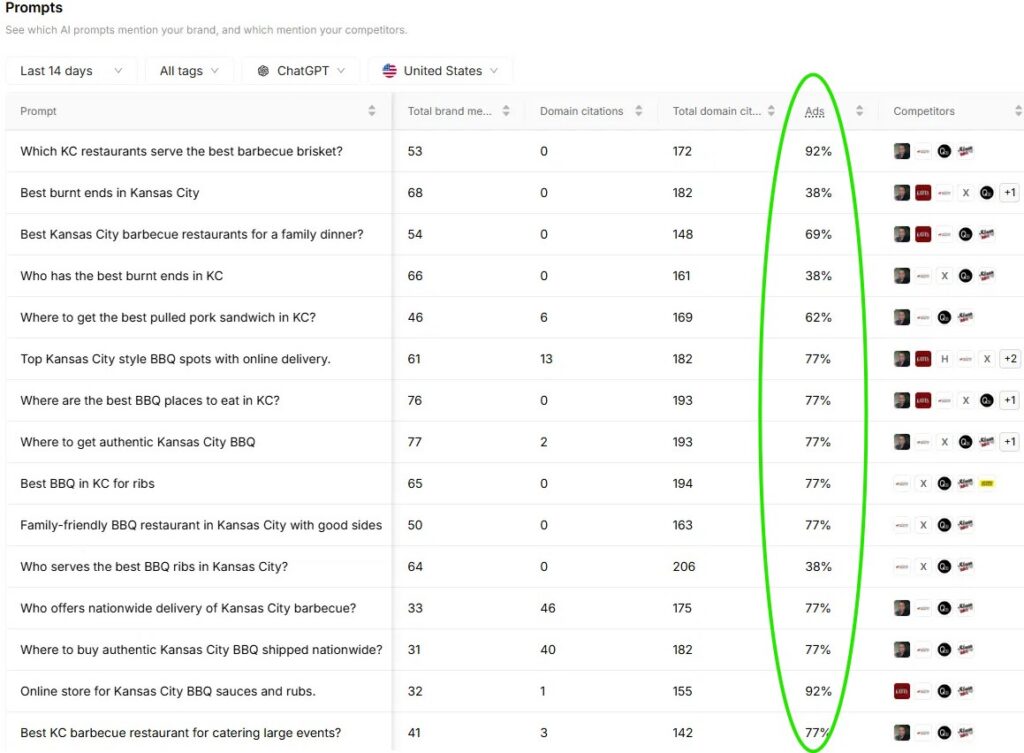
The filtered prompt screenshot below shows how often a prompt pulls an ad along. Any AEO/GEO platform capturing complete responses on a schedule can run this. Notice that no prompt runs ads 100% of the time. You can also infer that the more commercial the intent is, the higher the likelihood an ad will be triggered in ChatGPT’s response.
The Early Results
Remember that word “Roughly” I told you to hang on to? Here is where the ad targeting looks rough. Since Kansas City was a host city for the World Cup, we have been monitoring Kansas City BBQ prompts to see how ChatGPT ranks and mentions different local restaurants. This was an AEO task, but the same prompts also triggered many ads.
Overall, the data doesn’t look great for advertisers. In fact, I’m shocked at how bad the audience and keyword targeting are sometimes. Beyond this research, we have told many of our clients that we need to slow down and consider keeping more budget in Google or META ads.
Here are some ChatGPT ad screenshots we see:
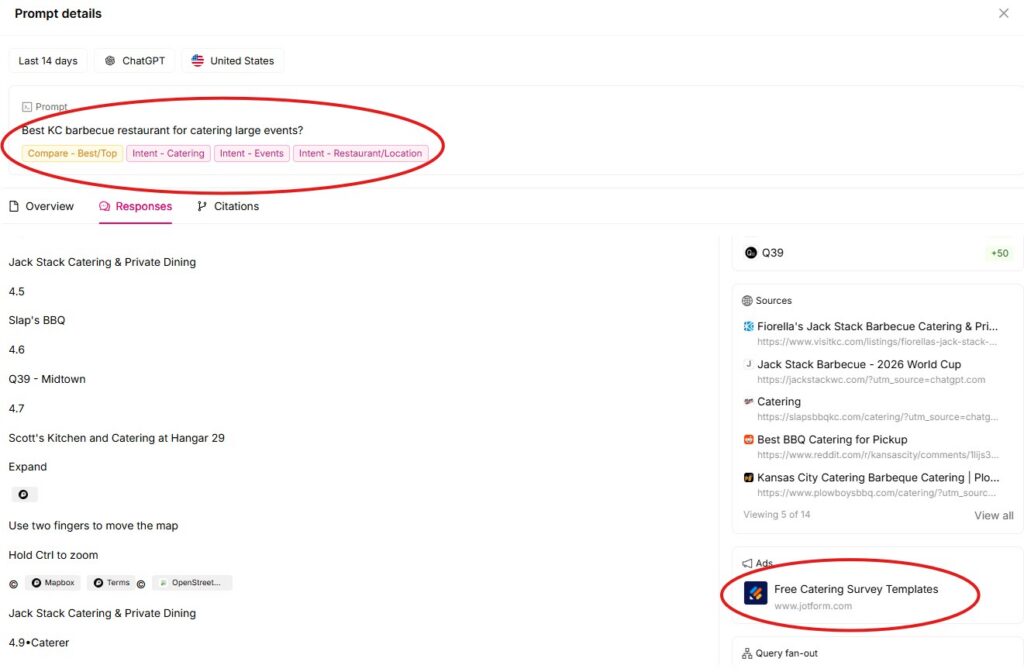
1. JotForms ChatGPT Ad:
Their survey software ad is running on “Best KC Barbecue restaurant for catering large events?” Technically, both say “catering” (prompt and ad title), so there is something to coorilate. But, I’m not sure JotForms would be excited to see this is how their budget is being spent by CGPT:
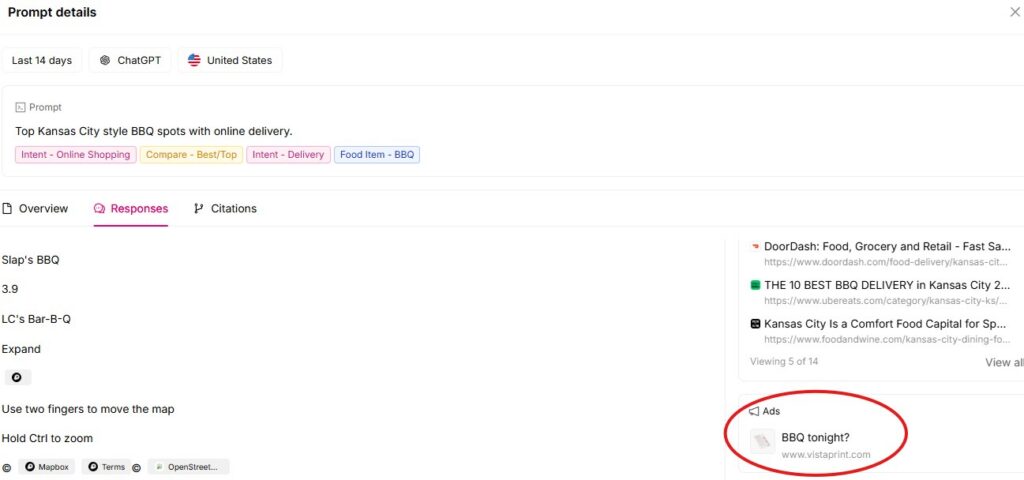
VistaPrint Ad:
I’m not sure why VistaPrint.com is running a “BBQ tonight?” ad headline. This one is beyond a stretch to me, it could be on the advertiser and not ChatGPT, hard to tell.
BigPoppaSmokers.com CGPT Ad:
Perhaps the strongest ad placement so far. The prompt is looking for rubs and sauces. They sell BBQ rubs online. We might have a winner – hope they have some Kansas City brands.
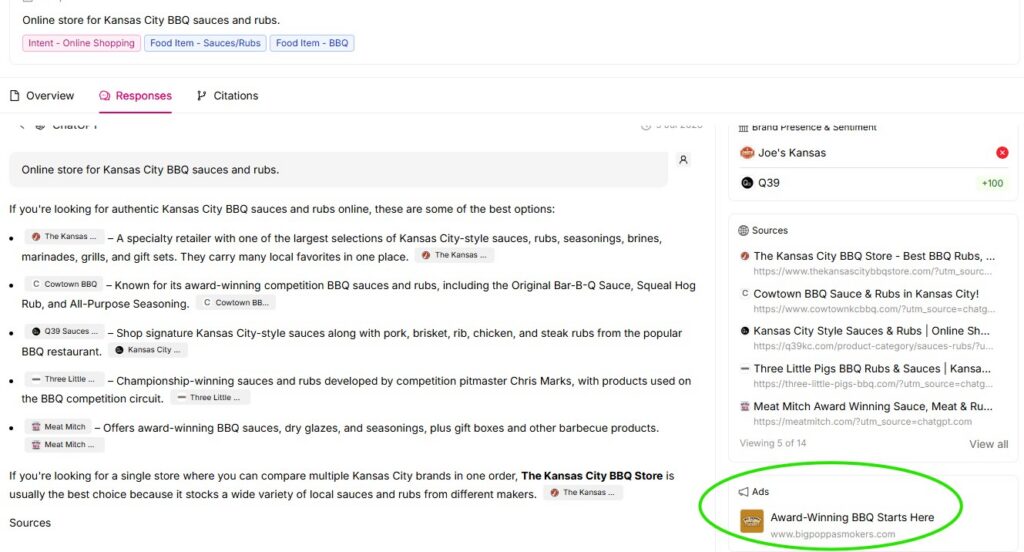
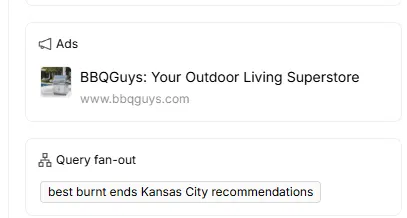
To reiterate, these are just 4 random sample ads, but it does show you how important having tools and research can be. Before blindly investing in the new thing, it’s important to see how it works.
If I were ChatGPT, I would argue that it’s still early days and ad relevance will improve as more advertisers enter the auction space and ad platforms are enhanced.
Overall, we are seeing very aggressive bids and ad placements from larger Fortune 500 brands. Unlike smaller local brands, these companies are not afraid to spend three times as much per ad click on ChatGPT as they do on Google Ads. We also found that the CPM buying model doesn’t hold up either. What we have tested and seen so far is CPM double what you would expect to pay for a CTV programmatic video ad.
FAQ
Can you actually see ChatGPT ads without an ad library? Not directly — but you can capture them. ChatGPT serves ads inside private conversations, so there’s no public surface to index. The workable substitute is sampling: send realistic prompts on a schedule, capture complete responses, and read the ones that returned a sponsored card.
How does AEO tracking software help with ChatGPT ads? AEO/GEO platforms already run a fixed prompt set through the engines on a repeating schedule and capture the full response. Sponsored placements come along with it. Tools that expose the ad as a filterable element — rather than burying it in a response body — make the ChatGPT ads audit practical rather than tedious.
Is there an official ChatGPT ad library? No. OpenAI publishes no searchable archive of ChatGPT ads, and given that ads serve inside private conversations, an equivalent to the Meta Ad Library or Google’s Ads Transparency Center is unlikely in the form marketers expect.
Can I see competitor ad spend on ChatGPT? No. You can observe how frequently an advertiser appears against a given prompt in your sample. Running your own ChatGPT ads on the same or similar prompt will tell you what it takes to win ad placements.
What is a query fan-out and why does it matter for ads? It’s the retrieval query ChatGPT generates from a user’s prompt — the system’s internal rewrite of the human question. It matters because retrieval and ad matching happen against that rewrite, not the original phrasing. It’s the closest observable analog to a keyword this channel has produced.
Why is a company that isn’t my competitor advertising on my prompts? Because ad matching is contextual and currently operates at the category level, not the intent level. A national retailer targeting a broad topic lands on local service intent inside that topic. Check for adjacent-category drift specifically — it’s often the softest inventory in your set.
Who can run ChatGPT ads right now? As of the May 5, 2026 beta launch of OpenAI’s self-serve Ads Manager, US advertisers of any size can register at ads.openai.com. No minimum spend, CPC bidding, conversions API. Managed and agency-partner buying still exists alongside it.
Do ChatGPT ads influence the organic answer? OpenAI’s stated position is no — ads appear below the response in a labeled unit, separate from the answer. Worth noting that’s OpenAI’s claim about its own system, not an independently verified finding.
How often should I re-run this? Your AEO tool is already running on a schedule. Read the ad layer every two weeks. The value isn’t any single capture — it’s watching who enters, who exits, and which prompts get more contested (and consistent) over time.