Google just told us how to actually optimize for AI Search.
A plain-English breakdown of Google's brand-new May 2026 guidance — what to do, what to ignore, and the popular "AI optimization" tactics your agency should stop charging you for.
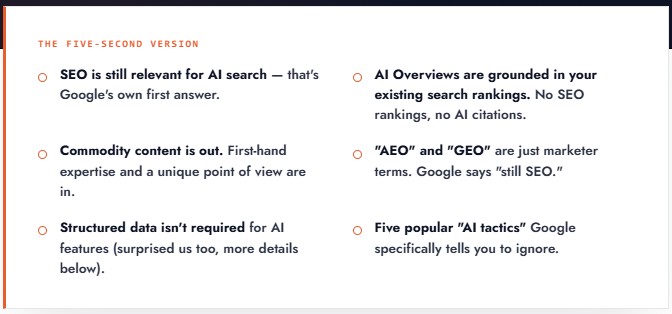
- SEO is still relevant for AI search — that's Google's own first answer.
- AI Overviews are grounded in your existing search rankings. No SEO rankings, no AI citations.
- Commodity content is out. First-hand expertise and a unique point of view are in.
- "AEO" and "GEO" are just marketer terms. Google says "still SEO."
- Structured data isn't required for AI features (surprised us too, more details below).
- Five popular "AI tactics" Google specifically tells you to ignore.
On May 15, 2026, Google quietly published the clearest official statement yet on how to optimize a website for AI search. The guide is short. The implications are not.
If you've been reading marketing newsletters this year, you've been told a dozen contradictory things — that you need an llms.txt file, that you need to "chunk" your content, that you need to hire an "AEO specialist," that you need to rewrite every page in question-and-answer format. Most of this doesn't survive contact with what Google actually published.
Here's what the guidance says, what it means for your strategy, the tactics Google explicitly tells you to ignore, and the questions clients send us most often — answered.
01 — How AI Search WorksTwo concepts behind every AI Overview.
Google opens with their own question: "Is SEO still relevant for generative AI search?" Their short answer: yes — and the reason matters.
The AI features in Google Search (AI Overviews, AI Mode) aren't separate from regular search. They're built on top of it. Two techniques drive the whole system, and once you understand them, most of the popular AI optimization advice falls apart on its own.
Grounding (Retrieval-Augmented Generation)
When you see an AI Overview, the model isn't pulling answers from its training data. It runs live searches against Google's normal index, retrieves real pages, reviews what's on them, and uses that information to generate the response — with clickable links back to the sources.
Google calls this grounding. The technical term is Retrieval-Augmented Generation (RAG). The practical consequence is simple: if your page isn't already eligible to appear in regular Google Search results, it cannot appear in AI Overviews either.
That's the entry ticket to AI features. Your content has to be crawlable, indexable, and pass the basic Search technical requirements before any "AI optimization" matters at all.
Query fan-out
When someone types a conversational query, Google's model doesn't just run that one search. It generates a cluster of related searches behind the scenes and combines the results to build an answer.
Google's own example: a search for "how to fix a lawn that's full of weeds" might fan out into "best herbicides for lawns," "remove weeds without chemicals," and "how to prevent weeds in lawn" — all running concurrently in the background. Your page needs to rank well across that whole constellation, not just the original query.
02 — What to Actually DoThree foundations Google says will move the needle.
Google's guidance organizes effective work into three buckets. Get these right and you're optimizing for AI search — by name or not.
1. Create valuable, non-commodity content
Google is explicit: this is the single highest-leverage thing you can do. They draw a sharp line between two categories:
Commodity (avoid)
- "7 Tips for First-Time Homebuyers"
- "What Is Freight Brokerage?"
- "How to Choose a PEO"
- "Benefits of Professional Organizing"
- Anything an AI could write from public knowledge alone
Non-commodity (invest here)
- "Why We Waived the Inspection & Saved Money" — first-hand
- "What Happens When a Bill of Lading Goes Missing" — case study
- "PEO vs. ASO: Cost Breakdown From an Actual Switch"
- "Inside a 3-Day Garage Reset" — before/during/after photos
- Original data, expert analysis, lived experience
Google's broader list of what makes content win here:
- A unique point of view. First-hand reviews and original takes outperform summaries of existing content.
- People-first writing — the same standard Google has applied to "helpful content" for years.
- Clear structure with paragraphs, sections, and headings that help readers navigate.
- High-quality images and video. AI Overviews can surface visual content, giving you more ways to appear.
- Don't manufacture pages for every fan-out variation. Google calls this out by name as a scaled content abuse trigger.
2. Build and maintain a clear technical structure
This section is short in the source document, but it's where most websites quietly fail. If Google can't crawl, render, and index your page cleanly, none of your content investment matters.
Technical foundation checklist
- Page is indexable and eligible to appear in normal search with a snippet (the prerequisite for AI features).
- Crawling is unblocked — no robots.txt blocks, no rendering issues, no broken canonicals.
- JavaScript SEO best practices are followed if your site relies on JS frameworks.
- Semantic HTML is used where reasonable (helps screen readers and browser agents both).
- Page experience is solid — Core Web Vitals, mobile rendering, low latency, clear main content.
- Duplicate content is minimized so Google doesn't waste crawl budget on pages you don't care about.
- Search Console is verified so you can actually see what's happening.
3. Optimize your local business and e-commerce details
For brick-and-mortar businesses and retailers, AI responses pull commercial and local information from structured sources first — not from your blog posts. The highest-leverage actions:
- Google Business Profile — fully complete: hours, services, photos, products, Q&A, and reviews. This is what AI Overviews pull from for local results.
- Merchant Center feeds — every attribute populated, accurate, and current. This is the gateway to AI-powered shopping experiences.
- Business Agent — Google's emerging conversational experience that lets customers chat directly with your brand from Search. Worth exploring if your business model supports it.
03 — Stop Doing ThisTactics Google explicitly tells you to ignore.
If your current agency is selling you any of the following, point them to the Google documentation. The page exists. It just doesn't say what they're telling you.
Kevin's Reality Check:
If you have one, leave it. If you don't, it's not a big deal. I have one. Rankfuse.com/llms.txt is a thing - but it's honestly not doing much. There are some great case studies to support this as well. Also, another reminder this is Google, other LLMs may use it.
In fact, Google says llms.txt isn't needed for AI features, while Lighthouse now checks the file for agentic browsing readiness in an experimental audit.
Kevin's Reality Check:
Hire a professional who can help you know when/where/how to sitemap your website. Content is still king, but can rot.
We have seen sites that do this continue to drop rankings and traffic over time. Quality over quantity is key. If your SEO strategy is "more is more", you need to rethink things. Consider your content is a garden and your the gardener. If you never pull the weeds the flowers don't look as good.
Kevin's Reality Check:
I agree. This should have been part of your SEO strategy years ago. AEO brought this back in 2025, but Google is trying to put a lid on it.
This is tricky because other LLM's are not like Google (it may work). However, this is your copy, You own it! You can't say your a victim of spamm here. IMO, Google could look at this as a red flag. More time and measurement is needed. SEO's may be slowest to react here.
Kevin's Reality Check: I'll say: don't forget about ChatGPT, CoPilot, and Claude - when "noise" is all there is, we see it being cited as a source.
Pay close attention to the word "filtered" - it can't be a negative (like owned content). If it was, your competition would leverage it against you. It can't hurt you, but it can be ignored.
Final thought on this is authorship. I'm seeing LLMs use listials, but looking harder at reputation (EAT) signals.
Kevin's Reality Check:
Use it when it makes sense, but no need to overstuff your HTML with it.
This is where Google's left hand doesn't talk to the right (again). Just three days ago, Google announced the FAQ schema is sunsetting in SERPs. Schema is important for data communication and indexation. It's not some huge AI-search lever that hacks your brand to the top. Honestly, it's not worth the hype you may read on LinkedIn. But, to ignore it (especially for e-commerce) is also foolish.
Kevin's Reality Check:
Let's push the "SEO is dead" (again) out a few more years.
Reguardless of search engine, LLM, microphone, or keyboard search - SEO is always evolving, and what makes my job fun.
I can't name one SEO expert who is not already looking at Answer Engine Optimization (AEO) as a way to expand their agency services and expertise.
04 — What's Coming NextAgentic experiences and the Universal Commerce Protocol.
Worth knowing about. Not worth panicking over yet.
Google is preparing for a future where autonomous AI agents — software acting on a user's behalf — browse websites to complete tasks like booking a reservation, comparing product specs, or making a purchase. These agents analyze visual renderings, inspect the DOM, and interpret the accessibility tree to figure out where to click.
The emerging standard for agent-driven transactions is called the Universal Commerce Protocol (UCP), and Google has confirmed it's something they're building toward.
For most businesses, this is a "stay informed" item, not an urgent action item. But if you run an e-commerce site or take bookings online, the practical groundwork — clean structured data, working transaction flows, machine-parseable pricing, semantic HTML — pays off in both directions: it's good for users today, and it's what agents will need tomorrow.
This guide focuses on Google's optimization guidance. Their separate document covers what happens when you use AI to create the content itself — the short version is that AI-assisted writing is fine, but pure AI output with no human judgment tends to fail Google's quality bar and can trigger scaled content abuse penalties.
The full Google guidance is here: Using generative AI content. If clients are asking, that's the source to point them to.
Questions clients keep asking us.
The exact answers we give when a client emails their account manager asking what they should be doing differently. Copy them. Use them. Send them to your team.
Is traditional SEO still relevant now that Google uses AI?
Yes — and Google's own guidance opens by answering this exact question. AI Overviews are grounded in Google's normal search index using a technique called Retrieval-Augmented Generation. The links you see under an Overview are real ranking results.
The practical implication: if your page isn't indexed and eligible to appear in regular Search with a snippet, it cannot appear in AI features. SEO isn't a separate game from AI search. It's the same game.
Do we need to hire someone for AEO or GEO?
No. Google's exact framing: "From Google Search's perspective, optimizing for generative AI search is optimizing for the search experience, and thus still SEO."
What people call AEO or GEO is foundational SEO executed well — strong content with unique expertise, clean technical structure, and optimized local and e-commerce signals. If an agency is selling you AEO as a separate service, ask them what specifically they're doing that isn't already covered by good SEO. The answer matters.
Should we add an llms.txt file or special AI markup to our site?
No. Google has directly stated you don't need to create machine-readable AI text files, special markup, or Markdown variants to appear in their generative AI features. Standard HTML and clean technical SEO is what their systems read.
If you're seeing vendors charge for "AI-readability" services built around these files, they're selling something Google's systems don't use. Read the link to the case study in the Myth section.
What about Schema.org structured data? Doesn't that help AI?
This one catches people by surprise. Google explicitly says structured data isn't required for generative AI search, and there's no special schema.org markup you need to add for AI features.
That said — keep using structured data anyway. It's still how you qualify for rich results in regular Google Search (product snippets, FAQs, recipes, events, reviews, and so on), and those rich results matter for click-through rates. Just don't believe anyone claiming Schema is the secret to ranking in AI Overviews.
Can we use AI to publish hundreds of pages targeting question-based searches?
This is one of the fastest ways to get penalized. Google's guidance calls it out by name: producing content "primarily to manipulate rankings or generative AI responses" violates the scaled content abuse policy. They specifically reference creating pages for every fan-out variation as an example of what triggers it.
Google's AI handles synonyms and intent natively, so you don't need separate pages for "best CRM for realtors," "top realtor CRMs," "real estate agent CRM software." One comprehensive page outperforms ten thin ones and avoids the penalty entirely.
How do we get our products or local business featured in AI search results?
AI features pull commercial and local data from structured sources first. The highest-leverage actions:
1. Optimize your Google Business Profile completely. Hours, services, photos, products, Q&A, and active review responses — all of it.
2. Maximize your Merchant Center feed if you sell products online — every attribute, every variant, accurate pricing and availability.
3. Explore Google's Business Agent rollout, which lets customers chat with your brand conversationally from Search results.
4. Make sure your foundational SEO is solid — AI features can't pull from your site if your site isn't indexed and eligible to appear in regular Search.
What's query fan-out and should we be optimizing for it?
Query fan-out is what happens behind the scenes when someone enters a conversational search. Google's AI silently runs multiple related searches at once and combines the results to assemble an answer.
You don't optimize for fan-out by writing more pages. You optimize for it by writing deeper pages. A piece that thoroughly covers a topic — its sub-topics, common objections, related questions, and edge cases — will land in more fan-out branches than ten shallow pages each targeting a single phrase. Comprehensive beats scattered every time.
Our competitor publishes tons of thin AI content and is ranking. What gives?
Two things usually explain this. First, Google's enforcement isn't always immediate — sites can ride a wave of thin content for months before a core update or manual action takes them out. Second, what looks like "thin AI content" from the outside sometimes has subtle quality signals you can't see (real reviews, original imagery, internal expertise, brand authority).
Either way, betting your business on the strategy Google's policy explicitly targets is a poor risk profile. Recovery from a scaled content abuse hit is long, expensive, and uncertain.
What should we actually be investing in for 2026?
Four priorities, in this order:
1. First-hand expertise content. Case studies, original research, behind-the-scenes processes, before-and-afters, and proprietary data. Anything an AI cannot synthesize from public web content.
2. Technical foundation. Indexable pages, clean crawling, working JavaScript rendering, solid Core Web Vitals, and minimal duplicate content. Without this, nothing else matters.
3. Local and product surfaces. Google Business Profile and Merchant Center feeds are where AI features pull commercial information — and they're often underinvested.
4. Topical depth, not breadth. Fewer pages, each one comprehensive enough to land in the fan-out branches around your topic.
Notice what's not on this list: Schema-as-secret-weapon, AEO retainers, llms.txt files, content chunking, AI mention campaigns. Google specifically tells you to skip all of those.
Want to know where your site actually stands?
We'll audit your domain against Google's current AI-search criteria — content depth, technical foundation, Google Business Profile and Merchant Center health, and scaled-content risk exposure. No commitment, no obligation.
Related Google documentation: Using generative AI content · Creating helpful, reliable, people-first content · Scaled content abuse spam policy · Search technical requirements.
Last reviewed: May 2026. Google's AI search guidance is evolving — if you're reading this more than six months after publication, contact us for the current version.