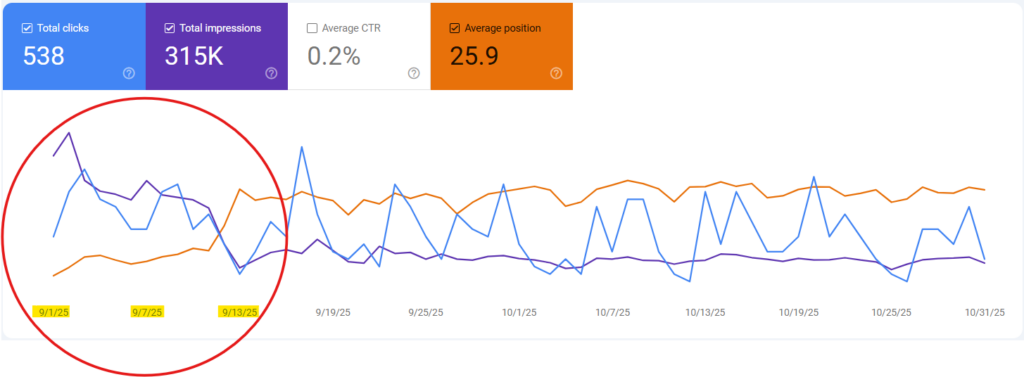

If you noticed a sharp drop in impressions in Google Search Console around mid-September 2025, you’re not alone.
For many sites, clicks have remained steady (or even increased). Average position has increased. Revenue is flat or up. Yet impressions suddenly fell off a cliff.
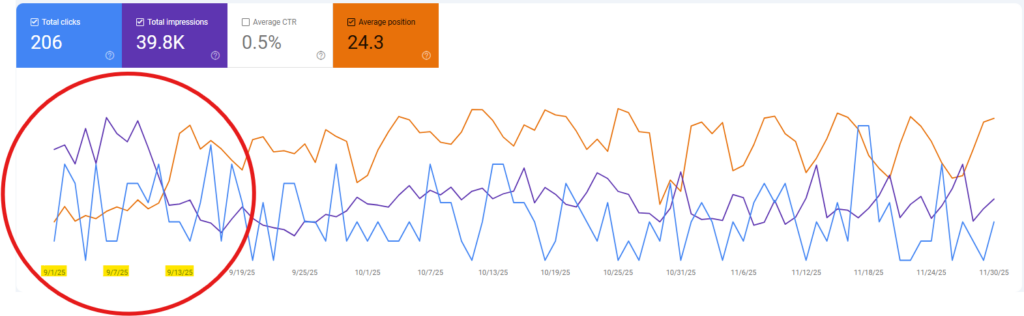
The Short Answer
In September 2025, Google stopped honoring the long-standing &num=100 URL parameter, a change that affected how search results are rendered and, by extension, how impressions are counted in Google Search Console.
This appears to be a measurement change, not a ranking or algorithm penalty.
What was the &num=100 Parameter?
For years, adding &num=100 to the end of a Google search URL would return up to 100 organic results on a single page instead of the default 10.
Google never officially promoted this feature, but it was widely known and heavily used within the SEO industry. Rank-tracking tools, crawlers, and other automated systems relied on it to quickly collect large volumes of ranking data in a single request.
Rather than paging through results one screen at a time, tools could retrieve positions 1 to 100 instantly.
As of mid-September 2025, this parameter no longer works. Search results are now effectively capped at the default page size.
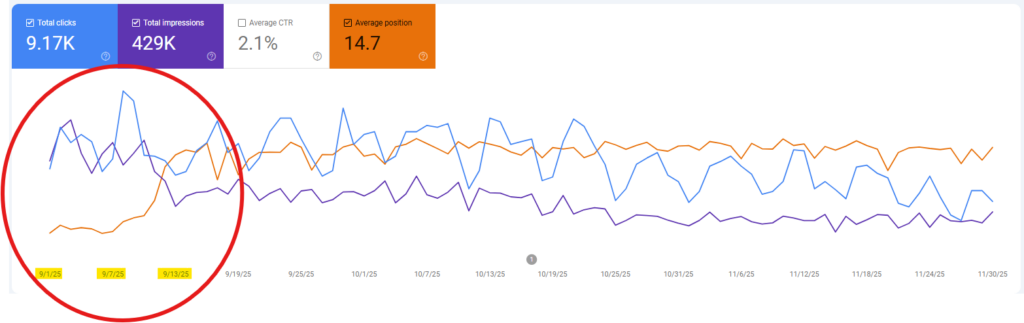
Why Did Impressions Drop?
To understand the impact, it helps to revisit how Google Search Console defines an impression.
An impression is recorded when a URL is rendered on a search results page—not when it is clicked, and not necessarily when a human scrolls far enough to see it.
Before the Change
If a rank-tracking tool queried Google using &num=100, all results on that page were rendered at once. That meant a site ranking at position #75 or #90 could still receive impressions in Search Console, even though no real user ever scrolled that far.
After the Change
With results limited to the default page size, deeper rankings are no longer rendered unless someone (or something) paginates forward multiple times.
Most automated tools no longer crawl that deeply because it is slower, more expensive, and easier to detect. As a result, many URLs that previously generated impressions via automated rendering simply no longer do.
The outcome is a sudden drop in total impressions, especially for sites with large keyword footprints outside the top 10 to 20 positions.
This may appear alarming, but it does not reflect a loss of actual user visibility.
Is This a Ranking or Algorithm Change?
There is no evidence that this change affected rankings, indexing, or Google’s evaluation of content. Most sites reporting impression drops saw no corresponding decline in clicks, conversions, or average position.
Everything suggests that this is a reporting and rendering change, rather than an SEO penalty.
Why Did Google Make This Change?
Google has not published an official explanation. Any discussion of motivation should be viewed as informed speculation rather than a confirmed fact.
That said, several plausible explanations are widely discussed in the SEO community:
1. Reducing Automated Scraping (Speculation)
Limiting results per request makes large-scale scraping more costly and slower. This may discourage excessive automated data collection, including rank tracking and other non-human usage.
While this could incidentally affect AI data harvesting or competitive scraping, Google has not confirmed this as a goal.
2. Infrastructure Efficiency (Speculation)
Rendering 10 results instead of 100 reduces server load and improves response times. Standardizing result delivery may help Google optimize performance at scale.
Again, this is logical but unconfirmed.
3. Cleaner Reporting (Observed Effect)
Regardless of intent, the result is that Search Console impression data now appears to align more closely with actual user exposure, rather than automated rendering.
This is an observable outcome, even if it was not the primary motivation.
How to Adjust Your Reporting Going Forward
Because this is a structural change, historical comparisons need context.
Re-Baseline Your Data
Do not directly compare impression totals from before and after mid-September 2025.
Add an annotation in Google Search Console and analytics platforms, noting the change. October 2025 should be treated as a new baseline for impressions.
Focus on Page-One Visibility
Impressions outside the top 10 are now more challenging to generate and less impactful. Many tools are responding by capping tracking at the top 20 to 30 positions.
Rather than tracking total keyword counts, prioritize:
- Share of voice in the top 10 search positions
- Keywords with real click potential
- Queries that drive conversions
Prioritize Clicks and Outcomes
Impressions are a soft metric. Clicks, conversions, and revenue are not.
If impressions decline but clicks and conversions remain stable, your SEO performance has not deteriorated—your reporting has simply become more grounded in human behavior.
The Bottom Line
The September 2025 Google Search Console impression drop is not a penalty, an algorithm update, or a sign that your site is losing relevance.
It is the result of a long-standing, unofficial shortcut being removed, one that inflated impression counts through automated rendering rather than real user exposure.
While the change may feel uncomfortable, it ultimately provides a clearer view of how real people interact with search results.
In that sense, this shift isn’t bad news but more honest data.